
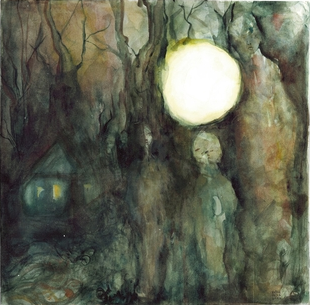
Quadeca wasn’t supposed to be alive for the release of I Didn’t Mean to Haunt You. Almost a year before its release on November 10, 2022, the 22-year-old former YouTube rapper said on Twitter, “I’m currently sitting on the greatest ever posthumous album.” And yet, Quadeca is still alive, this haunting album serving as his life-saving therapy.
I Didn’t Mean to Haunt You follows a character, presumably Quadeca, as a ghost living in the static after committing suicide. Rather than moving peacefully into the afterlife, he is stuck in limbo, restless, and unable to move on. He witnesses his loved ones mourn his death and is resentful that he’s still alone. Ultimately, he accepts his fate and is consumed by the static.
The success of I Didn’t Mean to Haunt You lies in the haunting atmosphere Quadeca creates, lyrically and sonically. Quadeca, who wrote and produced most of the album, sings and raps over synths and strings. Nearly all of the songs start with his vocals and a few instruments before building to a crescendo, oftentimes creating an overwhelming and emotional atmosphere.
The opening track, “sorry4dying,” introduces an eerie, lullaby-esque synth motif that recurs on later tracks “picking up hands” and “fantasyworld,” both of which, like “sorry4dying” consider the ghost’s childhood memories. In other words, on “sorry4dying” Quadeca sets the blueprint for what to expect from the rest of the album: otherworldly layers of distorted, glitchy vocals, strings, piano, and percussion.
The first single from the album, “born yesterday,” expresses the ghost’s anger toward his mother – “I think you’re goddamn lying” – as he watches her move on from his untimely death. Quadeca chooses an evocative sample of The Beatles’ “For No One,” to haunt the bridge and final chorus. McCartney’s voice breaks through layers of static and distortion, as the Beatles’ words are used to indict the ghost’s mother: “And yet you don’t believe her / She no longer needs you.”
The record takes an even more sinister turn with Danny Brown’s feature on “house settling,” where he raps from the perspective of carbon monoxide gas. Brown’s signature high-pitched, nasal voice combines with heavy industrial production, reflecting the ghost’s nightmarish mental state the as he tries to poison his family in a desperate attempt to not be alone. Sonically contrasting this is the aforementioned “fantasyworld,” a 7-minute emotional piano ballad where the ghost remembers his human self longing for death. Quadeca does his usual but effective climatic crescendo before abruptly cutting off all instruments but quiet piano and strings in the outro, singing in his falsetto, “And I float mountains away / Where no one can stay / And I go / Not in a rush.” In these lines, we hear the moment he decides to die.
The final track, “cassini’s division,” featuring Thor Harris of Swans, gives a terrifying description of the moment the ghost died, dissolving into a static, limbo state somewhere between reality and the afterlife. Quadeca speaks in a low, monotonous voice that turns into a whimper as he struggles with the transition. The track and album end with a 3-minute static outro representing this change of state as he leaves the world behind. And yet, with this album, Quadeca is resurrected; he saves himself through his art and is born again.